AI retention for subscription teams
A different cancel flow for every subscriber worth keeping
Tenure’s AI reads your pricing page and your Stripe catalog and writes the flow. Then it runs it wherever a subscriber can leave — the cancel screen, your support chat, the failed card — deciding per person what, if anything, to offer.
You don't build the flow — it arrives written
The AI reads your pricing page, your Stripe catalog and your own cancel reasons, and writes the flow for you.
Every discount has to earn its place
It scores what each subscriber is actually worth, and spends a discount only where it changes the answer.
Nobody slips out a door you don't cover
Most tools only guard the cancel button. Tenure also works in your app, your emails and your support chat.
The AI writes it before you build anything. No card, no call, nothing to install.
Monitor
Draft cancel flow
6 reasons, ranked by your own tickets
priced from plan margin · budget capped
shown when an offer is refused
always reachable · never blocked
How it decided
Annual · 14 months · $189/yr
Switch to monthly at $17
Keeping them at a price that works beats discounting a plan they were leaving.
Costs you $24 / year · inside your cap
An example workspace. Put your own domain in above.
Switch to monthly, $17
Right customer, wrong plan
No offer at all
Spending here buys a month
Pause for 60 days
Not price — attention
An illustration of the decision, not real subscribers.
At subscribers paying $ a month, churning %, you are losing $41,040 a year. Every point you win back is $9,120.
Retention that works on every channel a subscriber can leave through, and reports what it actually earned.
The difference
Six questions, and the two different answers
No jargon in this table on purpose. If you only read one section, read this one.
What almost everyone runs today
With Tenure
Who gets an offer?
Everyone who clicks cancel, including the people who were never really going to leave.
Only the people an offer is likely to keep. Everyone else goes straight through.
What do they get?
The same discount, whoever they are. Usually 20% off.
A different answer per person, priced against what that plan actually earns you.
Where does it work?
The cancel button on your website. That is it.
Your website, your mobile app, the link in an email, and your support team's screen.
Who builds it?
You do, in a form builder, and again every time pricing changes.
The AI writes the first version from your own site and billing. You edit it.
What does it cost you?
A discount with no end date, on revenue you would have kept anyway.
A budget you set. When it is spent, the offers stop on their own.
What do you learn from it?
A count of accepted offers, which tells you nothing about what to change.
Which reasons cost you the most, which offers are not worth their price, and who to stop discounting.
A week of it
The work it takes off you
Not a dashboard to check. A list of things that happened while you were doing something else — including the ones where the right answer was to let someone go.
What Tenure handled this week
example workspaceThe counts illustrate a week’s shape. Every action on the list is one the product takes today.
Where the AI is
The flow you launch is not the flow that runs in June
Everyone says AI now, and mostly means a chatbot. Writing the flow is the easy part. This one keeps deciding, keeps learning from what worked, and keeps proposing changes — inside limits you set.
A configured flow
One offer, chosen once, shown to everybody.
Three of the four get a discount that was wrong for them — two would have stayed without one.
Tenure
One answer each, from what it knows about them.
One discount instead of three, and the two who were staying cost nothing.
A worked example of the difference, not a customer result.
It answers per person, not per plan
Two people cancelling the same plan the same afternoon get different answers. One takes a discount every year; the other never has.
Why it matters: A static flow picks one offer for everyone. That is how blanket discounts leak margin.
Scored before any offer is generated
It gets better without you touching it
Offers re-rank from what actually worked for subscribers like this one. March's flow is not June's.
Why it matters: Everything else is configuration: set once, decays, revisited when churn spikes.
Learns per segment, inside your caps
It tells you what to change, with the receipts
When an offer stops earning its cost, Tenure writes the proposal: what to change, what it saves, why. You approve it or you do not.
Why it matters: Knowing something is wrong is the easy half.
Every proposal carries its own evidence
It reads, instead of asking
It looks at your pricing page, your catalog and the reasons people gave. Churnkey asks you to describe your flow in a text box; Sirius asks for a call.
Why it matters: Someone has to design the thing first. Not here.
Evidence it collected, not a brief you wrote
And the one place it does not: it never decides what it may spend. Budgets, discount depth and who qualifies are yours, enforced before the model is asked anything.
Coverage
One cancellation. Four places it can happen.
The cancel button is the one every tool covers. The others get bolted on as separate products with separate reporting, or skipped.
And the button is the last signal. The flow can fire on a URL you nominate, so someone who lands on your cancel page without pressing anything still gets the attempt.
Where it runs
See the decision where it actually happens
Not as a chart. On the screen your subscriber is looking at when they decide to go.
In the support chat
The agent is handed one offer and the limits it may not cross.
Subscriber
I want to cancel my membership.
Agent
Before you go — I can pause your plan for 60 days, free, and keep your progress.
On the cancel button
In your brand, on the page that already has the button.
Northbeam / account
Why are you leaving?
In the payment-failed email
The card failed at 3am and nobody clicked anything.
Subject
Your Northbeam payment did not go through
Retry 2 of 4. A one-month credit is offered on attempt 3 if it fails again.
The offer quadrant
Some of your discounts are buying back people who were never leaving.
Every offer placed by what it saves against what it costs. Bottom-left is margin you can have back.
Typical first finding
Two or three offers are doing almost all the work, and one long discount is quietly costing more than the subscribers it keeps.
Offer library · save rate × margin kept
example workspaceEverything in it
Six jobs, and one place they all report to
Setup from your app
AI reads your site and billing, then writes the flow.
Read moreCancel widget
The save flow that runs where people actually cancel.
Read moreAI agent access
Give a support agent the offer, and the limits it may not cross.
Read moreOffer reporting
Which discounts are worth what they cost you.
Read morePayment recovery
Failed cards, and the subscriptions they quietly end.
Read moreWin-back
The ones already gone, and when it is worth asking again.
Read moreTry it
Run the decision yourself
Pick a subscriber and a reason. This is the rule Tenure applies, with the arithmetic shown — including the times the right answer is to let someone go.
1 · Who is cancelling
2 · What they said
What Tenure does
Worth $228 a year, 14 months in and never discounted — the discount is small against what staying is worth.
What it weighed
A simplified version of the real rule: no billing catalog, no usage history, no budget ledger. The product reads all three from your own account before it decides anything.
Not a mockup
This is the product deciding
Every attempt, on every surface, with what it was offered and what happened — and the score that decided it.
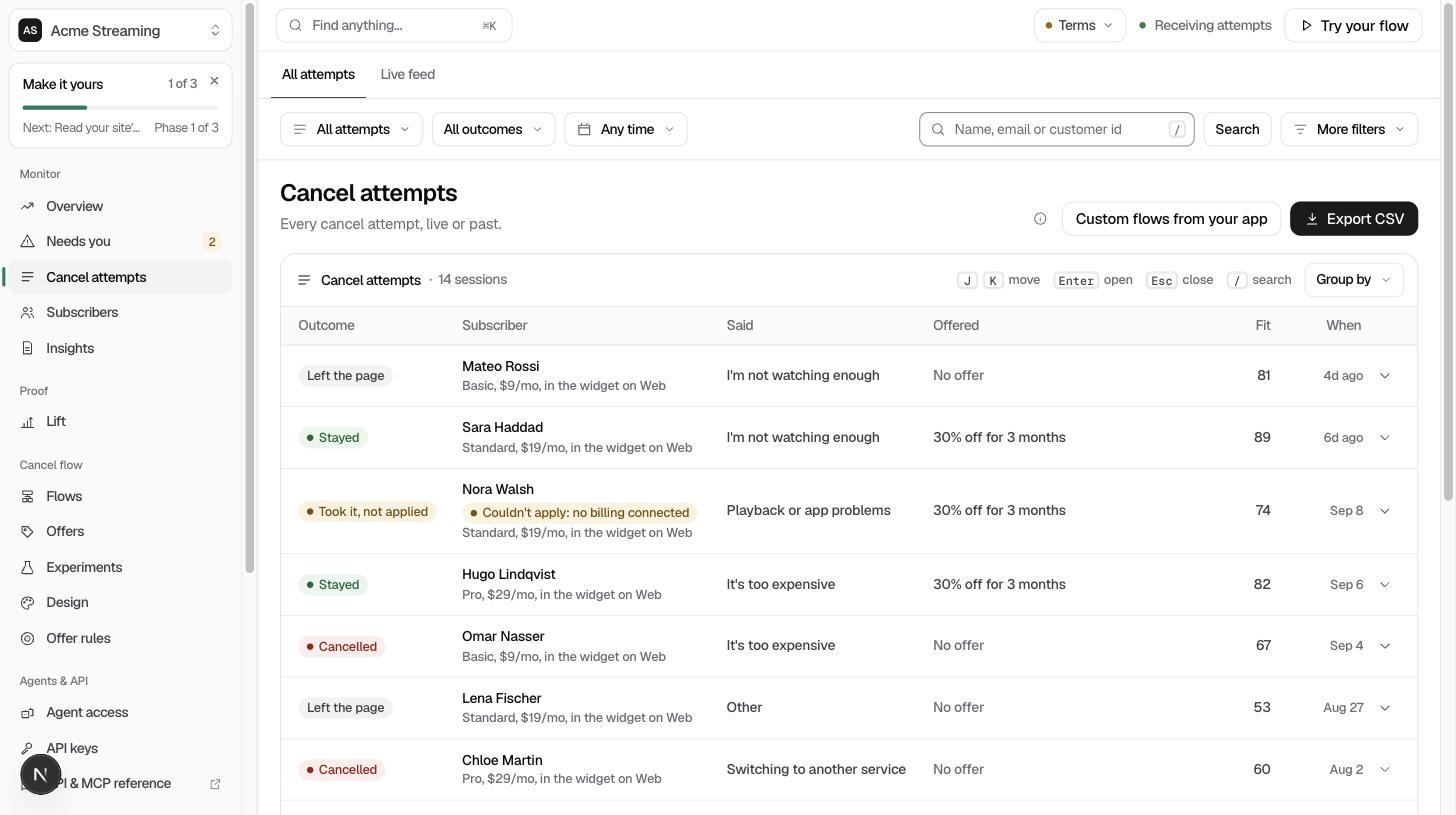
Same reason, two answers. Both told us they were not watching enough. The $9 subscriber was let go; the $19 one was worth an offer, and stayed. A demo workspace — the subscribers are seeded, the decisions are the product’s own.
Connects to
It reads what you already have
Only the services you connect receive data. Anything else reaches Tenure through an endpoint you host.
Enterprise
Built to survive a security review
Roles and permissions
example workspaceAudit rows
184,220
Chain
Verified
Retention
365d
The exact detail, in the exact words, is on the trust page →
For developers
One script tag, or none at all.
The widget is a single tag on the page that already has your cancel button. If you would rather not render anything, the same decisions are available over REST and to an AI agent connection.
<script
  src="https://cdn.trytenure.ai/widget.js"
  data-key="pk_live_..."
></script>

<button data-tenure-cancel>
  Cancel subscription
</button>
The cancel path always completes. If Tenure is slow or unreachable, the button does what it did before.
Compare
Deciding between us and someone else?
Tenure vs Churnkey
They are more mature and have the longer track record. We cover four cancel surfaces instead of one, and we tell you which offers are not worth their cost.
Read the comparison →Tenure vs Sirius
They have named customers and a case study at scale. We publish a price, and you can see the product without booking a call.
Read the comparison →Free under 100 cancel sessions a month. Give Tenure your domain and it writes the first draft — keep it, edit it, or throw it away.
What happens if Tenure is down?
The cancel path completes. If the script fails to load, times out or throws, the button does exactly what it did before it was marked. A confirmed cancellation is never replayed.
Can an AI agent give away more than I allow?
No, because the limits are not in the prompt. Budget, discount depth and who qualifies are enforced on the server before an offer is generated. The agent gets talking points, not authority.
How long does setup take?
The first draft exists in a few minutes. Installing it is one script tag plus your billing connection. Most of the time is you reading the draft and disagreeing with it.
Will it look like our product, or like yours?
Yours. It renders in its own sealed layer, so your styles and ours can never collide, and it picks up your page's colours, type and corner radius by itself. If you would rather set them explicitly, there are eleven variables for it.
Do all cancelling subscribers see an offer?
No, deliberately. Low-value and discount-seeking accounts pass straight through, and a share sees nothing at all so the reporting has something to compare against.